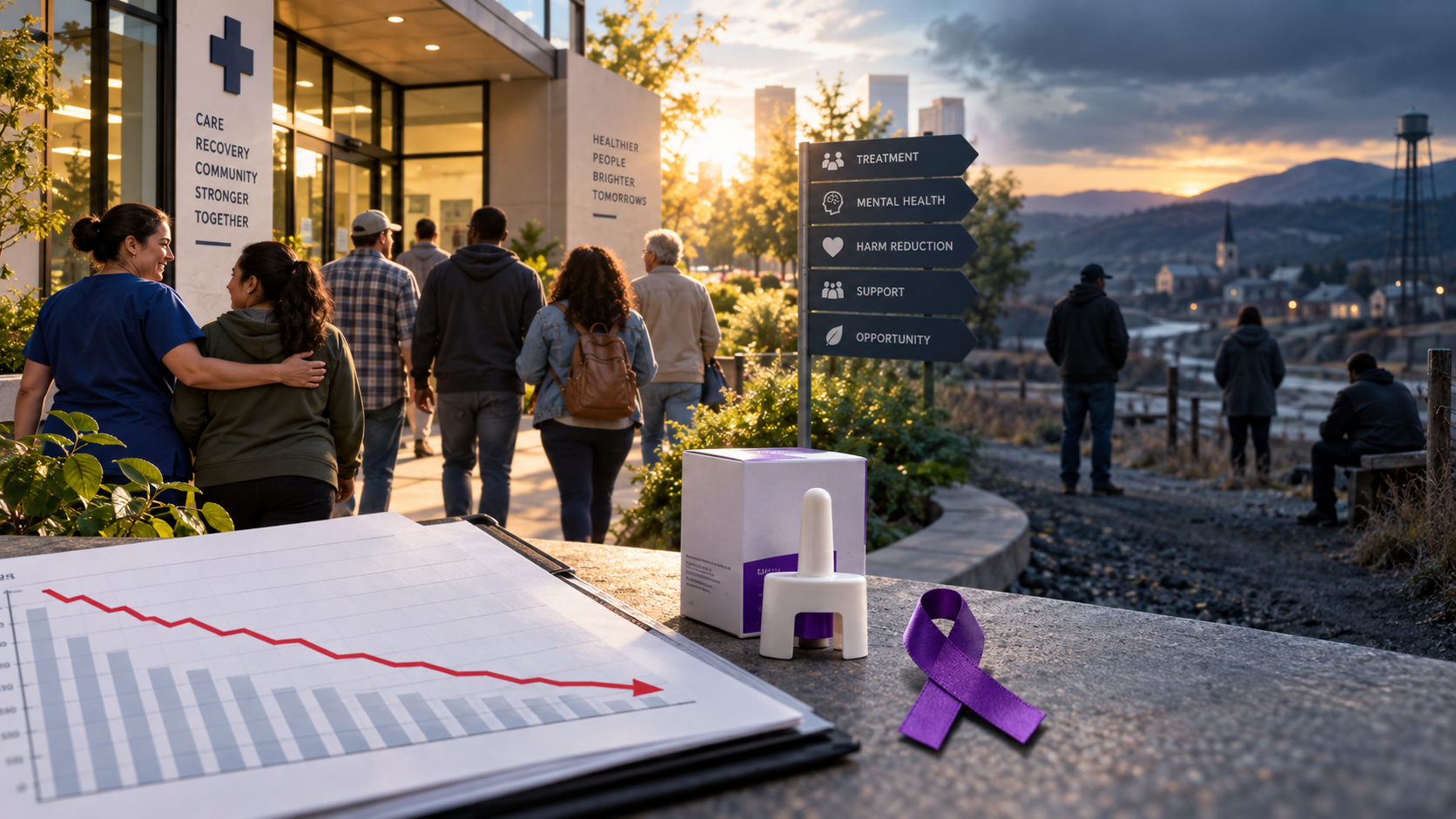
Why Overdose Deaths Are Falling — And Who’s Left Behind
By The Recover Editorial Team | Published September 11, 2026 | Last updated September 11, 2026
For the first time in a generation, the number that defined American public health for two decades is moving in the other direction.
Federal health officials estimate that 67,798 people died of drug overdoses in the United States during the 12 months ending in March 2026 — a 12.3% decline from the same period a year earlier. The figure was published by the Centers for Disease Control and Prevention on August 31, timed to International Overdose Awareness Day, alongside a new Overdose Prevention Data Channel that consolidates fatal and nonfatal overdose surveillance in one place.
It is the continuation of a trend that began in mid-2023 and has held. Provisional counts put 2025 at roughly 69,973 deaths, down nearly 14% from 81,313 in 2024 — a third consecutive annual decline. Measured from the peak, the fall is steeper still: the rolling 12-month total ran near 110,000 in June 2023 and had dropped to about 72,000 by August 2025.
What almost nobody working in this field will tell you with confidence is why.
What the numbers actually say
Two caveats belong at the front of any story built on these figures, because they get lost quickly once the number starts circulating.
- These are provisional counts, not final ones. They are early estimates drawn from death records available at the time of analysis, and they move. Overdose investigations can take months; toxicology results lag; reporting speed varies widely by state and county. The words the CDC uses — predicted, provisional, estimated — are load-bearing, and they should survive the retelling.
- Fatal and nonfatal overdoses are not falling at the same pace. Suspected overdoses accounted for 54.7 of every 10,000 emergency room visits between April 2025 and March 2026, a decline of just 2.6% year over year. Far fewer people are dying. Nearly as many people are still overdosing.
That gap matters. It suggests the country is getting better at keeping people alive through an overdose without having made comparable progress at preventing the overdose itself.
Why deaths are falling: four explanations, none of them settled
The provisional data release reports how many people died and over what period. It does not explain the cause. Researchers have spent two years trying to fill that gap, and the honest summary is that the leading candidates all have evidence behind them and none of them accounts for the decline alone.
The drug supply changed
The explanation with the most direct evidence behind it concerns the fentanyl market itself. Analyses of federal mortality data have pointed to reduced fentanyl potency — linked in part to Chinese controls on precursor chemical exports to Mexican manufacturing operations — as a primary driver of the 2024 drop.
A Brookings analysis published in August 2026 adds an important refinement: it may be the consistency of the supply, not its average strength, that matters most. Street drug analysis work cited in that review argues that fluctuation in fentanyl content drives overdose risk, because a person whose tolerance is calibrated to weak product is the one who dies when a strong batch appears. More consistent pill composition, on that account, saves lives even if average potency is unchanged. The same review notes that the presence of more xylazine in the supply may have contributed as well.
Fewer people are starting
A second explanation is demographic rather than chemical. Experts at a University of Pennsylvania panel in February attributed the improvement to a combination of fentanyl market changes, expanded naloxone and treatment access, and a shrinking pipeline of new users — fewer young people initiating opioid use after watching what it did to the people around them.
That reading is consistent with long-running federal survey data. Monitoring the Future and the CDC’s Youth Risk Behavior Survey have both documented substantial declines in adolescent cigarette smoking, alcohol use, and a range of illicit drugs over the past two decades.
It is also the explanation that should give policymakers the least comfort, because it is not something any agency did.
A shift from injecting to smoking
A third factor has received considerably less attention. A CDC study found that by 2022, smoking had overtaken injection as the most commonly documented route of drug use in overdose deaths, while injection-related overdose deaths fell. Research published in the International Journal of Drug Policy in 2024 reported that people who inject fentanyl face a higher risk of nonfatal overdose than those who primarily smoke it, and interviews with people who use drugs in San Francisco described smoking as producing a more gradual onset than the rapid effect associated with injection.
Harm reduction researchers caution against overstating this. Smoking fentanyl remains capable of killing someone. The claim is relative, not absolute.
Naloxone and treatment access — real, but probably not sufficient
The explanation most often offered in public is the one the evidence supports least well as a sole cause. The Brookings review concluded that neither expanded naloxone access nor the elimination of the X-waiver for buprenorphine prescribing produced effects of the magnitude needed to explain a roughly 50% reduction in fentanyl-involved deaths between June 2023 and August 2025.
This is not an argument that naloxone distribution or medication access failed. It is an argument about arithmetic. Both almost certainly saved lives; neither appears large enough to have done this on its own. Brookings’ own conclusion is that the real answer is some combination of supply-side change, demand-side adaptation, and the effects of community organizations doing daily harm reduction work that resists clean measurement.
Who the decline has left behind
A national average can conceal as much as it reveals, and this one does.
An analysis published in the journal Addiction in June 2026, drawing on CDC mortality records, found that overdose death rates fell across every racial and ethnic group in 2024 — genuine progress after years of widening gaps. But the gaps did not close. American Indian and Alaska Native individuals had the highest overdose death rate of any group in 2024 at 50.8 per 100,000, roughly 2.15 times the national average of 23.7, and experienced a below-average decrease of 20.1%. Black and African American individuals saw the largest single-year improvement of any group — a 29.3% drop — and still ended 2024 at 36.0 per 100,000, about 1.51 times the national rate.
The drugs involved track those disparities. Cocaine-involved overdose deaths with fentanyl excluded disproportionately affected Black Americans, reaching 3.13 times the national average by 2024. Methamphetamine-involved deaths disproportionately affected American Indian and Alaska Native individuals, at 3.24 times the national average. Xylazine-involved deaths ran at 1.66 times the national average among Black Americans.
And one category has not followed the decline at all. Deaths involving stimulants without fentanyl rose from 18,142 in 2023 to 18,907 in 2024. Because the overall total fell so sharply, that category expanded from 17.3% of all overdose deaths to 23.8% — close to a quarter.
This is the part of the story with the most direct consequence for how treatment is delivered. A national response built around opioid overdose reversal and opioid medications has no equivalent to offer for stimulants, where no medication treatment has been approved. As the opioid share of the crisis shrinks, the share that existing tools were not designed to address grows.
Why the trend is not guaranteed to continue
Recent policy changes have introduced real uncertainty into the forecast. In April 2026, SAMHSA announced that agency funding could no longer be used for drug use supplies including drug testing strips. Analysts at the Commonwealth Fund have also flagged reductions to Medicaid — the primary source of coverage for adults with opioid use disorder — as a significant risk to medication and naloxone access.
International comparisons underline how fragile these trends can be. Drug overdose deaths rose 32% in Argentina and 21% in Brazil between 2023 and 2024, increases the Commonwealth Fund analysis associates with disrupted social and harm reduction services amid broader instability.
A three-year decline is not a solved problem. It is a window.
What this means for families looking at the numbers
For someone with a family member using drugs, the national trend line is close to meaningless as a personal forecast. A predicted 67,798 deaths over 12 months still works out to roughly 188 people a day. The improvement is real and worth understanding, and it does not change what the risk looks like inside a single household.
What the research does suggest is that the factors moving the number are mostly structural — supply composition, who is starting, how drugs are consumed — rather than individual. That is an argument for meeting the problem with systems rather than willpower: naloxone kept where it can be reached, medication for opioid use disorder where it is indicated, and treatment that accounts for stimulants rather than assuming every case is an opioid case.
The Recover publishes resources on alcohol addiction, detox, and couples rehab, and maintains a directory of treatment centers across the country. Readers who would like help understanding what options are available can reach the team at 888-510-3898.
Sources
- Centers for Disease Control and Prevention, “CDC Launches New Overdose Prevention Data Channel,” August 31, 2026 — https://www.cdc.gov/media/releases/2026/cdc-launches-new-overdose-prevention-data-channel.html
- National Center for Health Statistics, Vital Statistics Rapid Release: Provisional Drug Overdose Death Counts — https://www.cdc.gov/nchs/nvss/vsrr/drug-overdose-data.htm
- Brookings Institution, “Exploring the sources of the decline in US drug overdoses,” August 6, 2026 — https://www.brookings.edu/articles/exploring-the-sources-of-the-decline-in-us-drug-overdoses/
- Penn LDI, “Experts Warn Addiction Policy is Weak Despite Falling Overdose Deaths,” February 19, 2026 — https://ldi.upenn.edu/our-work/research-updates/experts-warn-addiction-policy-is-weak-despite-falling-overdose-deaths/
- Friedman JR, Palamar JJ, Ciccarone D, et al. “Charting the Decline of the Fourth Wave: US Overdose Deaths by Race, Ethnicity, and Substance Involvement.” Addiction, June 2026 — https://pubmed.ncbi.nlm.nih.gov/41646704/
- Commonwealth Fund, “Overdose Mortality from a Global Perspective: Why Are Rates Falling?” September 2026 — https://www.commonwealthfund.org/publications/issue-briefs/2026/sep/overdose-mortality-global-perspective-why-are-rates-falling
- CDC, About Overdose Prevention — https://www.cdc.gov/overdose-prevention/about/index.html
Overdose death figures cited in this article are provisional estimates from the CDC’s National Vital Statistics System and are subject to revision as death records are finalized. This article reports published mortality data and research findings; it does not provide medical advice.