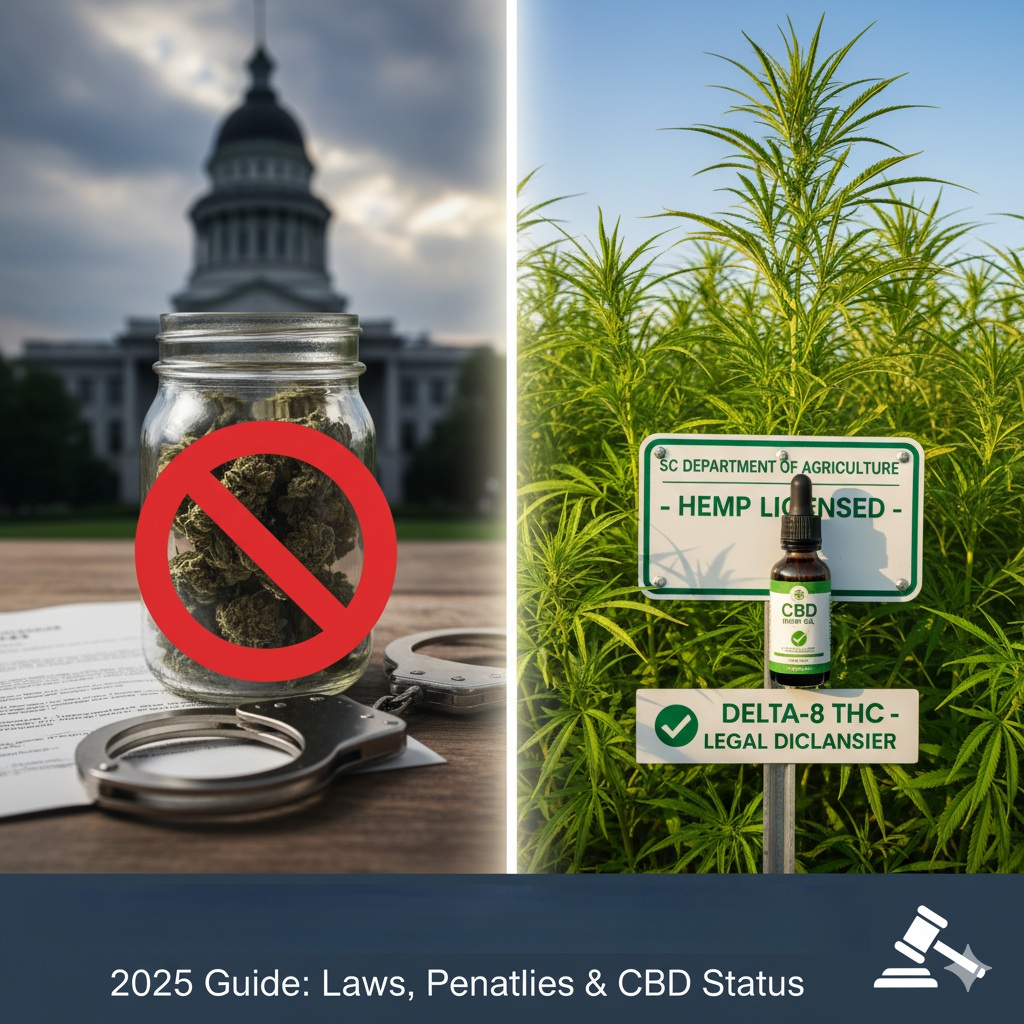
Is Weed Legal in South Carolina? Laws, Penalties & CBD Status
Is Weed Legal in South Carolina? The Legal Landscape — Where South Carolina Stands Today
🚫 Recreational Marijuana: Still Illegal in 2025
Despite growing national momentum toward legalization, South Carolina remains one of the most restrictive states in the U.S. when it comes to cannabis. As of 2025, recreational marijuana is not legal in any form. Possession, cultivation, and distribution are criminal offenses under state law.
This prohibition places South Carolina in stark contrast with neighboring states like Virginia, which have embraced recreational sales. For residents and visitors alike, the message is clear: do not bring marijuana into South Carolina, regardless of where it was legally obtained.
🩺 Medical Marijuana: A Narrow Exception
South Carolina does not have a comprehensive medical marijuana program. Instead, the state offers a limited exception under Julian’s Law, passed in 2014. This law allows patients with treatment-resistant epilepsy to use low-THC CBD oil, defined as containing less than 0.9% THC and more than 15% CBD.
There are no dispensaries, no medical marijuana cards, and no legal protections for patients with other conditions such as chronic pain, cancer, or PTSD. This makes South Carolina one of the few states without a full medical cannabis framework.
📜 The South Carolina Compassionate Care Act: Stalled Again
The South Carolina Compassionate Care Act, which would establish a regulated medical marijuana program, has been introduced multiple times since 2015. Despite bipartisan support and strong public backing, the bill has repeatedly failed to pass.
In 2024, the bill advanced through the Senate but was blocked in the House. As of September 2025, the legislation remains in limbo, with no clear path forward. Advocates continue to push for reform, but opposition from key lawmakers and law enforcement groups remains strong.
⚖️ Possession Laws: Misdemeanor vs. Felony
South Carolina law distinguishes between simple possession and possession with intent to distribute (PWID):
- Simple possession of less than 1 ounce is a misdemeanor, punishable by up to 30 days in jail and a $200 fine.
- Possession of more than 1 ounce, or evidence of distribution (scales, baggies, cash), can lead to PWID charges, which are felonies with penalties of up to 5 years in prison and $5,000 in fines.
Repeat offenses carry harsher penalties, including longer jail time and higher fines. South Carolina does not offer automatic expungement, but first-time offenders may qualify for Pre-Trial Intervention (PTI) or Conditional Discharge, which can lead to dismissal of charges upon completion of a court-approved program.
🧪 Drug Testing and Employment
South Carolina employers are not restricted from drug testing. They may legally test for marijuana and terminate employees who test positive, even if the cannabis was used legally in another state. There are no protections for medical cannabis users, as the state does not recognize out-of-state medical marijuana cards.
This policy has significant implications for workers in industries such as transportation, healthcare, and manufacturing, where drug testing is routine.
🌱 Part 2: CBD, Hemp, and THC Variants — What’s Legal, What’s Not
✅ CBD Oil: Legal with Limits
CBD oil is legal in South Carolina if derived from hemp and contains less than 0.3% Delta-9 THC. This aligns with federal law under the 2018 Farm Bill, which legalized hemp nationwide.
However, marijuana-derived CBD — even with low THC — remains illegal. Consumers should verify product labels and purchase from reputable vendors to avoid legal issues.
❌ Delta-8 THC: Controversial and Risky
Delta-8 THC, a psychoactive compound derived from hemp, occupies a legal gray area. In 2023, South Carolina’s Attorney General issued an opinion stating that Delta-8 is illegal under state law. Despite this, many retail shops continue to sell Delta-8 products, creating confusion for consumers.
Law enforcement has begun cracking down on Delta-8 sales, and possession may result in criminal charges. Until the law is clarified, consumers are advised to avoid Delta-8 products in South Carolina.
⚠️ Delta-9 THC Edibles: Legal via Loophole
Hemp-derived Delta-9 THC edibles are legal if they contain less than 0.3% THC by dry weight. This loophole allows for the sale of gummies, chocolates, and other edibles that produce mild psychoactive effects.
Retailers must comply with strict labeling and testing requirements. Consumers should be cautious, as exceeding the THC threshold can result in felony charges.
🧪 THCA Products: Legality Under Review
THCA (tetrahydrocannabinolic acid) is a non-psychoactive precursor to THC. When heated, it converts to Delta-9 THC. South Carolina has not explicitly banned THCA, but its legal status is uncertain.
Because THCA can be used to produce psychoactive effects, it may be considered illegal under the state’s broad definition of marijuana. Consumers and retailers should monitor legislative updates closely.
🛒 Where to Buy Legal CBD Products in South Carolina
Legal CBD products are widely available in:
- Health food stores
- Vape shops
- Online retailers
Consumers should look for:
- Third-party lab testing
- THC content below 0.3%
- Clear labeling of ingredients
Avoid purchasing from unverified sources, especially those selling Delta-8 or high-THC products.
🚨 Part 3: Penalties, Practical Advice & Legislative Outlook
🚔 What Happens If You’re Caught with Weed?
Let’s say you’re pulled over in Charleston with a small amount of marijuana. Here’s what could happen:
- You’ll be charged with simple possession, a misdemeanor.
- You may be arrested and taken to jail.
- You’ll face a court date, and if convicted, up to 30 days in jail and a $200 fine.
- If it’s your first offense, you may qualify for PTI or Conditional Discharge.
Repeat offenses escalate quickly. A second possession charge can lead to up to 1 year in jail and a $2,000 fine.
🧾 Can You Get a Marijuana Charge Expunged?
Yes — but only under specific conditions:
- First-time offenders who complete PTI or Conditional Discharge may have their records expunged.
- Felony charges are not eligible for expungement unless dismissed or reduced.
Expungement requires:
- Filing a petition
- Paying court fees
- Waiting periods (typically 3 years)
🗳️ Legislative Outlook: Will South Carolina Legalize?
Public support for medical marijuana is strong, with polls showing over 70% approval. However, political opposition remains entrenched.
Key lawmakers opposing reform include:
- House Speaker Murrell Smith
- Senator Greg Hembree
Advocates like Senator Tom Davis continue to push for change, but progress is slow. The 2025 legislative session may see renewed efforts, especially as neighboring states expand access.
🌐 Advocacy Resources
Stay informed with these trusted sources:
CBD, Hemp, and THC Variants — What’s Legal, What’s Not in South Carolina
South Carolina’s cannabis laws don’t just restrict marijuana — they also tightly regulate hemp-derived products, including CBD oil, Delta-8 THC, Delta-9 THC edibles, and THCA. For consumers, patients, and retailers, understanding the nuances of these laws is essential to avoid legal trouble and make informed decisions.
✅ Is CBD Oil Legal in South Carolina?
Yes — but only under specific conditions. In South Carolina, CBD oil is legal if it is derived from industrial hemp and contains no more than 0.3% Delta-9 THC by dry weight. This aligns with federal guidelines established under the 2018 Farm Bill, which legalized hemp nationwide.
However, marijuana-derived CBD oil, even with low THC content, remains illegal under state law. This distinction is critical for patients seeking therapeutic relief, as marijuana-derived CBD often contains higher concentrations of cannabinoids that may be more effective for certain conditions.
Where to Buy Legal CBD Products in South Carolina
CBD products that meet legal requirements are widely available across the state. You can find them in:
- Health food stores
- Pharmacies
- Vape shops
- Online retailers
When purchasing CBD, look for:
- Third-party lab testing
- Clear labeling of THC content
- Certificates of analysis (COA)
Avoid products that make unverified medical claims or lack transparency. The South Carolina Department of Agriculture oversees hemp regulation and provides guidance on compliant products through its .
❌ Is Delta-8 THC Legal in South Carolina?
This is one of the most contentious issues in South Carolina’s cannabis landscape. Delta-8 THC, a psychoactive compound derived from hemp, was initially sold legally under the assumption that it fell within the scope of the federal hemp definition. However, in October 2023, South Carolina’s Attorney General issued a formal opinion stating that Delta-8 is illegal under state law.
Despite this, many retailers continue to sell Delta-8 products, citing ambiguity in enforcement and federal protections. Law enforcement agencies have begun cracking down on these sales, and possession of Delta-8 may result in criminal charges.
What Consumers Should Know
- Delta-8 products are not safe from prosecution in South Carolina.
- Retail availability does not guarantee legality.
- Consumers should avoid Delta-8 until the law is clarified.
This legal uncertainty has led to confusion and frustration among consumers, especially those using Delta-8 for anxiety, pain, or sleep disorders. Advocacy groups like NORML have called for clearer legislation and consumer protections.
⚠️ Is Delta-9 THC Legal in SC Under Hemp Laws?
Surprisingly, yes — under very specific conditions. Hemp-derived Delta-9 THC is legal in South Carolina if it meets the federal threshold of 0.3% THC by dry weight. This loophole allows for the sale of certain edibles, beverages, and tinctures that produce mild psychoactive effects.
Examples of Legal Delta-9 Products:
- Gummies with 5–10mg of THC (as long as the total weight meets the 0.3% threshold)
- Chocolates and baked goods infused with hemp-derived THC
- Tinctures and oils labeled as “compliant” under the Farm Bill
Retailers must ensure that products are properly labeled and tested. Consumers should verify THC content and avoid products that exceed the legal limit, as possession of high-THC edibles can result in felony charges.
🧪 Are THCA Products Legal in South Carolina?
THCA (tetrahydrocannabinolic acid) is a non-psychoactive cannabinoid found in raw cannabis. When heated, THCA converts to Delta-9 THC, producing intoxicating effects. The legality of THCA in South Carolina is uncertain.
While THCA itself is not listed as a controlled substance, its potential to convert into THC raises legal concerns. The South Carolina Code of Laws broadly defines marijuana to include “any part of the plant” that can produce THC, which may encompass THCA-rich products.
Legal Risks of THCA:
- Possession of THCA flower may be interpreted as possession of marijuana.
- Retailers selling THCA products risk enforcement actions.
- Consumers should avoid THCA until the law is clarified.
As of 2025, no court has definitively ruled on THCA’s legality in South Carolina. Legal experts recommend erring on the side of caution and avoiding THCA products altogether.
🛒 Can You Grow Medical Marijuana at Home in South Carolina?
No. Home cultivation of marijuana is strictly prohibited in South Carolina, regardless of medical need. This includes growing cannabis plants for personal use, medical treatment, or research.
Violations are treated as felony offenses, with penalties including:
- Up to 5 years in prison
- Fines up to $5,000
- Asset forfeiture
Unlike states with medical programs that allow limited home grows, South Carolina offers no exceptions. Patients seeking cannabis-based treatment must rely on legal hemp-derived products or travel to states with medical reciprocity — though bringing marijuana across state lines remains illegal.
Penalties, Practical Advice & Legislative Outlook
🚔 What Happens If You’re Caught with Marijuana in South Carolina?
South Carolina enforces some of the strictest marijuana laws in the Southeast. If you’re caught with cannabis — even a small amount — the consequences can be serious.
Scenario: Caught with Less Than 1 Ounce
- Charge: Misdemeanor
- Penalty: Up to 30 days in jail and a $200 fine
- Driver’s License: Possible suspension
- Court Options: First-time offenders may qualify for Pre-Trial Intervention (PTI) or Conditional Discharge
Scenario: Caught with More Than 1 Ounce
- Charge: Possession with Intent to Distribute (PWID)
- Penalty: Felony, up to 5 years in prison and $5,000 in fines
- Additional Risks: Asset forfeiture, permanent criminal record
Repeat offenses escalate quickly. A second possession charge can result in up to one year in jail and a $2,000 fine. South Carolina does not offer automatic expungement, and felony convictions can severely impact employment, housing, and education opportunities.
🧾 Can You Get a Marijuana Charge Expunged?
Yes — but only under limited circumstances. South Carolina allows expungement for certain first-time offenses, including simple possession, if the individual successfully completes PTI or Conditional Discharge.
Requirements for Expungement:
- Completion of a court-approved program
- No additional criminal charges
- Filing a petition with the court
- Payment of administrative fees
- Waiting period (typically 3 years)
Felony charges, including PWID, are not eligible for expungement unless dismissed or reduced. Legal assistance is recommended for navigating the expungement process.
🗳️ Legislative Outlook: Will South Carolina Legalize Marijuana?
Despite strong public support, South Carolina’s path to legalization remains uncertain. The state has seen multiple failed attempts to pass medical marijuana legislation, most notably the South Carolina Compassionate Care Act.
Key Legislative Milestones:
- 2014: Julian’s Law passed, allowing limited CBD use
- 2015–2024: Compassionate Care Act introduced repeatedly, blocked in House
- 2025: Reform bills introduced but stalled in committee
Lawmakers Supporting Reform:
- Senator Tom Davis: Lead sponsor of medical marijuana legislation
- Representative Deon Tedder: Advocate for decriminalization and racial equity
Lawmakers Opposing Reform:
- Senator Greg Hembree: Vocal opponent of legalization
- House Speaker Murrell Smith: Has blocked reform bills from advancing
Advocacy groups like the Marijuana Policy Project (MPP) and NORML continue to push for change, but progress is slow. With neighboring states expanding access, pressure is mounting for South Carolina to modernize its cannabis laws.