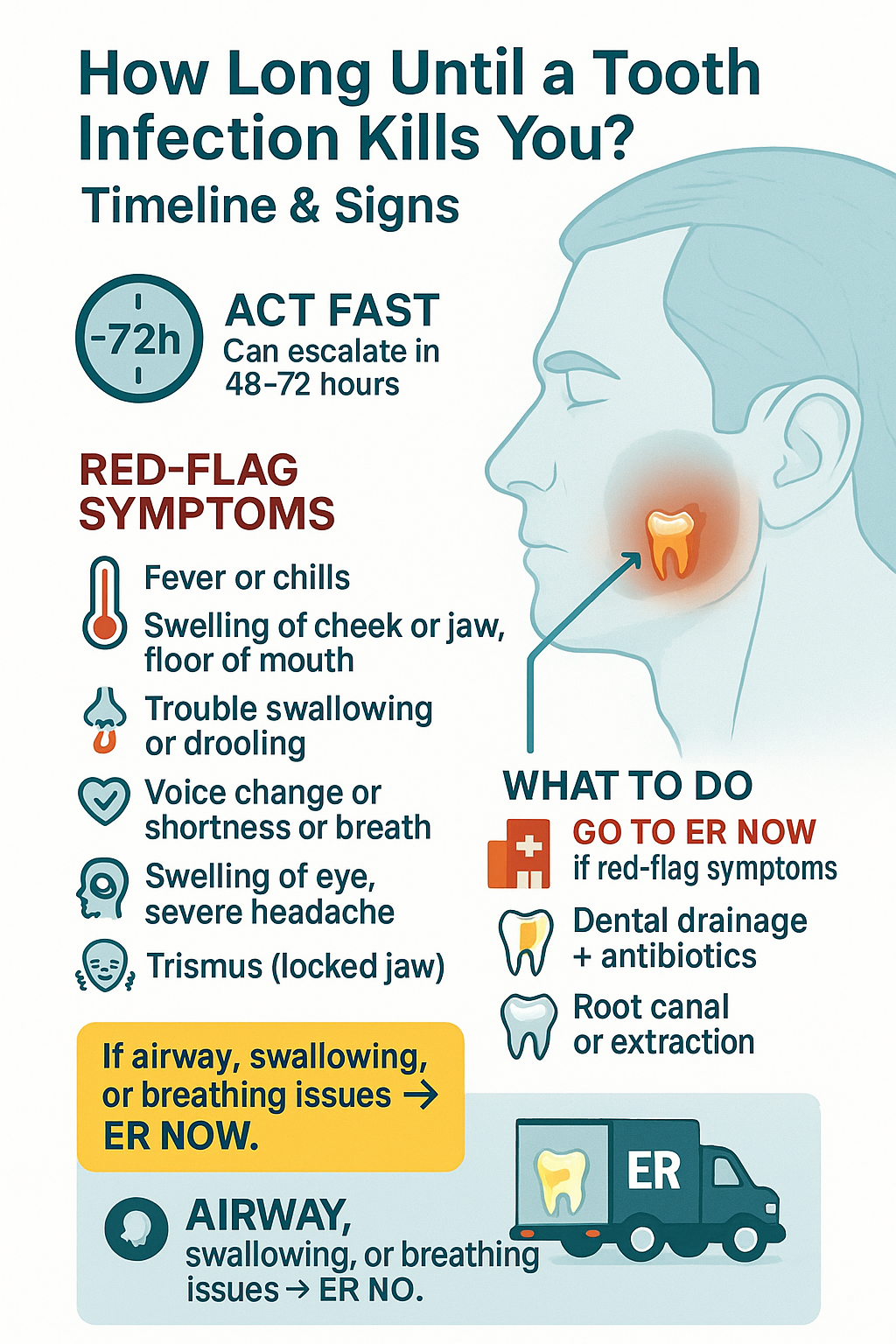
How Long Until a Tooth Infection Kills You?
How Long Until a Tooth Infection Kills You? A Realistic Timeline, Red-Flag Symptoms, and Exactly What to Do Next
By The Recover — trusted health guidance and referral support. This article is informational, not a substitute for professional medical or dental care. If you have facial swelling, fever with severe dental pain, trouble swallowing or breathing, or feel acutely ill, go to the ER or call 911.
TL;DR (read this first)
-
A dental abscess can escalate in days, not weeks, especially when swelling spreads into the jaw, floor of mouth, neck, or around the eye.
-
There is no single “death clock.” Progression depends on the tooth involved, the spaces the infection enters, immune status (diabetes, chemotherapy, steroids), and how quickly you get drainage + antibiotics + definitive dental treatment.
-
Go now (ER/urgent care) if you have: fever, chills, spreading swelling, severe pain, trismus (can’t open mouth), drooling, voice changes, difficulty swallowing/breathing, confusion, or rapid heartbeat.
-
Early treatment—drainage (root canal or extraction) plus appropriate antibiotics—is what prevents complications like Ludwig’s angina, sepsis, brain abscess, or cavernous sinus thrombosis.
Why people ask, “How long until a tooth infection kills you?”
Because the pain can seem “local” while the risk is systemic. Dental infections begin inside the tooth or gum, but the roots and surrounding spaces connect to critical areas—the airway, the neck’s fascial planes, and, via veins, the brain. That’s why terms like “tooth infection death timeline” or “can a tooth infection kill you in a few days” surge in search after someone develops swelling or fever. This guide answers those concerns without scare tactics—just clear signs, timelines, and actions.
The short answer about timing
-
Best case (treated early): With prompt dental care (drainage + antibiotics when indicated), most localized abscesses improve within 24–72 hours and are cured with definitive treatment (root canal or extraction).
-
Worst case (untreated & spreading): If infection tracks into deep neck spaces or the bloodstream, life-threatening complications can emerge within days. That is not common when people seek care early, but it’s exactly why delays are dangerous.
There is no universal number of days. What matters is trajectory: is swelling spreading? Are you developing systemic symptoms (fever, chills, fast heart rate)? Are there airway signs (difficulty swallowing, drooling, voice changes, shortness of breath)?
How fast can a tooth infection spread?
Fast enough to be an emergency. A periapical abscess can burrow through bone and follow the path of least resistance into the cheek, floor of the mouth (submandibular/submental spaces), the neck (deep cervical spaces), or around the eye via venous connections (risking cavernous sinus involvement). People often report that pain decreases just as swelling increases—that is not improvement; it’s a warning that the infection has changed compartments.
Key accelerators of spread:
-
Lower molars (roots near the floor of mouth and neck spaces)
-
Immunocompromise (diabetes, HIV, chemo, high-dose steroids)
-
Delays (self-treating with leftover antibiotics, heat/alcohol rinses, postponing drainage)
-
Tobacco, dehydration, poor nutrition
“Tooth infection death timeline”: what a realistic progression can look like
(This is a teaching framework—not a prediction. If you are worsening at any point, treat it as urgent.)
-
Day 0–2: Localized toothache; cold/heat sensitivity; gum bump (parulis) or swelling near a tooth. Over-the-counter pain meds help briefly.
-
Day 2–4: Spreading swelling in cheek, jawline, or under the tongue; increasing tenderness; fever/chills, malaise, headache; possible trismus (can’t open mouth), dysphagia (trouble swallowing), drooling.
-
Day 3–7: If untreated, risk of Ludwig’s angina (floor-of-mouth cellulitis that can threaten the airway), deep neck space infection, sepsis, cavernous sinus involvement (with eye pain/swelling), or rarely brain abscess. At this stage, hospital care (IV antibiotics, airway monitoring, surgical drainage) may be required.
Bottom line: Dangerous complications can appear within days if the infection has an easy path and no early treatment.
Symptoms that mean the infection may be spreading
Use this list as a one-minute self-check:
-
Fever and chills (yes, a tooth abscess can cause fever and chills)
-
Firm, tense swelling of cheek, jawline, floor of mouth, or under the tongue
-
Difficulty swallowing; drooling; voice changes (“hot potato voice”)
-
Shortness of breath or feeling you can’t lie flat comfortably
-
Eye pain/swelling, double vision, or severe headache (red flags for spread toward the orbit/brain)
-
Severe, spreading pain into the jaw, neck, or ear
-
Trismus (jaw stiffness; cannot open widely)
-
Tachycardia, lightheadedness, confusion (possible sepsis)
-
Worsening despite oral antibiotics, or symptoms return quickly after partial improvement
Specific complications (and the signs to know)
1) Can a tooth infection cause sepsis?
Yes. Sepsis is the body’s extreme response to infection and can lead to organ failure.
Watch for: fever or low body temp, rapid heartbeat, rapid breathing, confusion, low blood pressure, reduced urine output.
Action: ER now.
2) Ludwig’s angina (floor-of-mouth infection)
A rapidly spreading cellulitis under the tongue that can compromise the airway.
Watch for: elevated, firm floor of mouth; drooling, difficulty swallowing; “hot potato” voice; breathing changes.
Action: Emergency care immediately.
3) Brain abscess from a tooth infection
Rare, but odontogenic infections can seed the brain.
Watch for: severe headache, fever, neurologic changes (weakness, confusion), seizures, vomiting, visual changes.
Action: ER immediately.
4) Cavernous sinus thrombosis / orbital spread
Infections of upper teeth and sinuses can spread via venous channels.
Watch for: eye swelling/pain, double vision, eyelid droop, fever, severe headache.
Action: ER immediately.
5) “Can a tooth abscess cause heart problems?”
Indirectly, yes. Bacteria can enter the bloodstream; in at-risk people (certain valve disease, prior endocarditis, prosthetic valves), there’s concern for endocarditis. Discuss antibiotic prophylaxis with your clinician if you have specific cardiac conditions.
How long does it take for a tooth infection to become life-threatening?
There is no fixed number of days. Some infections stay localized for weeks; others track into high-risk spaces within a few days. The trajectory is your guide:
-
Localized pain + small gum bump → urgent dental visit within 24 hours.
-
Fever, spreading swelling, trismus, trouble swallowing, or feeling systemically ill → ER or urgent care now.
When people ask, “Can a tooth infection kill you in a few days?” the honest answer is: it can become life-threatening that fast if it gets into the wrong spaces and you delay drainage.
What actually cures a dental abscess?
Drainage + Source Control + Antibiotics (when appropriate) + Definitive Dental Care
-
Drainage: Abscesses improve when they’re opened and drained. That may be an incision into the gum, or inside the tooth via root canal to relieve pressure.
-
Source control: If the tooth is unsalvageable, extraction removes the source.
-
Antibiotics: Helpful after drainage or when swelling is spreading/systemic. Taking antibiotics without drainage can temporarily reduce symptoms while the pocket persists—risking rebound or spread.
-
Definitive care: Completing the root canal or properly restoring/extracting the tooth prevents recurrence.
Do not self-start leftover antibiotics or stop early; that increases resistance and can mask worsening.
“How to know if a tooth infection is getting worse”
-
Pain that moves from tooth → cheek/jaw/neck
-
Your mouth opening is shrinking (trismus)
-
New fever/chills, fatigue, body aches
-
Swallowing pain, voice change, drooling
-
Headache or eye symptoms (upper teeth infections)
-
You feel sicker despite OTC pain meds or after a few doses of an antibiotic
Treat this as urgent—the goal is drainage now, not “wait and see.”
When to go to the ER for a tooth infection
Go now if any are present:
-
Difficulty breathing or swallowing, drooling, inability to lie flat
-
Rapidly increasing swelling of face, jaw, or floor of mouth
-
Fever with rigors/chills, confusion, racing heart
-
Eye swelling/pain, double vision, severe headache
-
You’re immunocompromised (e.g., chemo, advanced diabetes) and symptoms are worsening
-
You can’t access urgent dental care and symptoms are escalating
How quickly can a tooth abscess spread to the jaw?
“Jaw” can mean mandible or maxilla (the bones) as well as adjacent fascial spaces. Infections can erode through bone and travel along these spaces after just a few days. If you see firm, tense swelling along the jawline or under the tongue, do not delay. That is a higher-risk pattern requiring same-day care.
What to do if a tooth infection is spreading (step-by-step)
-
Call a dentist or emergency dentist immediately (same-day).
-
If you have red flags (fever, trismus, swallowing/breathing issues, spreading swelling) go to the ER.
-
Do not apply heat to the face/neck (can worsen spread). Use cool compresses externally for comfort.
-
Hydrate (room-temperature water or electrolyte solution).
-
Take OTC pain relievers as directed by your clinician (avoid aspirin if bleeding risk).
-
If prescribed, start antibiotics promptly and complete the course—but remember: antibiotics do not replace drainage.
-
Arrange the definitive procedure (root canal or extraction) as scheduled; don’t stop after the first day of relief.
Prevention: the quiet power moves
-
Routine dental care (cleanings/exams) to catch small cavities and cracks early
-
Fluoride toothpaste; avoid frequent sugary/acidic snacks/drinks
-
Replace worn fillings/crowns before bacterial leakage irritates the pulp
-
Manage dry mouth (saliva substitutes, hydration, review meds)
-
Control diabetes and other conditions that impair immunity
-
Mouthguard for bruxism (night grinding cracks enamel)
-
Don’t ignore lingering sensitivity—this is how small problems become abscesses
Myth vs. Fact
-
Myth: “If the pain stops, the infection is gone.”
Fact: Pain can decrease when an abscess drains into tissue—often as swelling is spreading. -
Myth: “Antibiotics alone cure dental abscesses.”
Fact: Antibiotics help, but drainage + definitive treatment are what cure the source. -
Myth: “Only bad teeth cause dangerous infections.”
Fact: Even a cracked tooth or failed prior filling can seed an abscess that spreads quickly.
Frequently Asked Questions (schema-ready content)
1) Can a tooth infection really kill you?
Yes—if untreated and it spreads to deep neck spaces, the airway, bloodstream (sepsis), or brain. Early care (drainage + antibiotics + procedure) makes these outcomes rare.
2) How long does it take for a tooth infection to become life-threatening?
It varies from person to person. Some infections stay local for weeks; others can become dangerous within days—especially with lower molars, rapid swelling, fever, or immune compromise.
3) What are the first signs that a tooth infection is spreading to my body?
Fever/chills, worsening swelling, jaw stiffness (trismus), trouble swallowing, malaise, fast heart rate. Treat this as urgent.
4) What are the symptoms of a tooth infection spreading to the brain?
Severe headache, fever, neurologic changes (confusion, weakness), visual symptoms, vomiting, seizures. ER immediately.
5) What are the signs of sepsis from a dental abscess?
Fever or low temperature, rapid heart rate, rapid breathing, confusion, low blood pressure. Medical emergency.
6) How do I know if my tooth infection is an emergency?
Any airway/swallowing issue, rapidly spreading swelling, fever with rigors, or you feel acutely ill. When in doubt, go to the ER.
7) What happens if a tooth abscess goes untreated?
It can create fistulas, destroy bone, spread into neck spaces, cause sepsis, or (rarely) brain/eye complications.
8) Can a tooth infection cause heart problems?
It can introduce bacteria to the bloodstream; in people with specific heart conditions, there’s risk for endocarditis. Ask your clinician about antibiotic prophylaxis before dental procedures if you’re in a high-risk group.
9) When should I go to the emergency room for a toothache?
If you have fever, spreading swelling, difficulty swallowing/breathing, trismus, eye symptoms, confusion, or you’re immunocompromised and getting worse.
10) Is it possible for a tooth infection to go away on its own?
Symptoms can wax and wane, but the source rarely resolves without drainage + definitive dental care. Waiting increases risk.
Related searches we answered in this guide
-
How fast can a tooth infection spread?
-
Tooth infection death timeline
-
How long does it take for a tooth infection to become life-threatening?
-
Can a tooth infection kill you in a few days?
-
How quickly can a tooth abscess spread to the jaw?
-
Signs a tooth infection has spread to the bloodstream
-
Symptoms of tooth infection spreading to the brain
-
How to know if a tooth infection is getting worse
-
Signs of a severe dental abscess
-
Can a tooth abscess cause fever and chills?
-
Symptoms of tooth infection spreading to the jaw or neck
-
Can a tooth infection cause sepsis?
-
Sepsis from dental abscess symptoms
-
Tooth infection causing Ludwig’s angina
-
Brain abscess from a tooth infection
-
Can a tooth infection cause septic shock?
-
Signs of a dental infection in the blood
-
Can a tooth abscess cause heart problems?
-
What to do if a tooth infection is spreading
-
When to go to the ER for a tooth infection
Final word from The Recover
Medical crises don’t wait for perfect timing. If your gut says “this is getting worse,” trust it. Seek urgent dental care or go to the ER. If anxiety, fear, or past trauma has kept you from the dentist, tell the triage nurse or dentist exactly that—good clinicians will meet you with compassion and a plan.
If you need help finding urgent care or navigating benefits, The Recover connects people to evidence-based, compassionate providers every day. Your next step can be as simple as making one call—today.
In an emergency or if you have red-flag symptoms, call 911 or go to the nearest emergency department immediately.